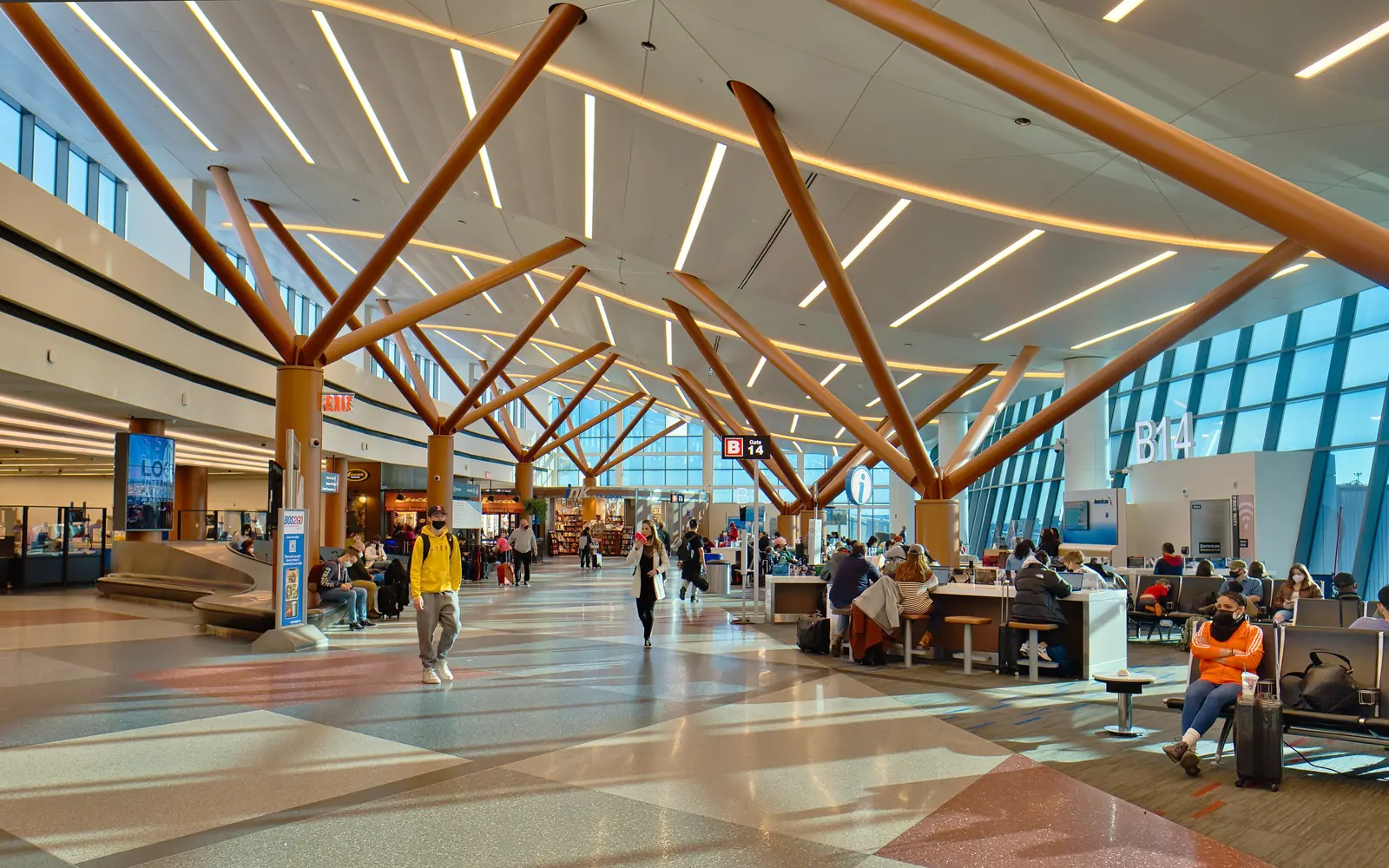
Be at BOS two hours before a domestic departure and three before an international one. That still doesn’t tell you what time to leave the house, so put in your departure time and adjust the drive, parking and bags.
Try it with your own flight
Tap the departure time and set it to the one on your ticket.
Tap any duration and change it to how long that step really takes you.
Every start time shifts so you can see when to leave and when to start packing.
Departure
15 minFinal pack & check12:40 PM
20 minDrive to BOS12:55 PM
10 minPark & walk in1:15 PM
15 minBag drop & boarding pass1:25 PM
25 minSecurity at BOS1:40 PM
10 minWalk to the gate2:05 PM
15 minAt the gate early2:15 PM
30 minBoarding2:30 PM
Departure3:00 PM
Every row is editable. Tap the departure or any duration and the plan recomputes backward. The first travel row is your leave-by time.
Travel time to BOS
The 20-minute drive is a typical run from Boston without traffic. In the app, set Boston Logan International as the destination and Apple Maps fills in the time from where you’re leaving.
🚗 20 min
🚗 Drive🚶 Walk🚴 Cycle
20 minDrive to BOS
Still check traffic for the hour you’ll go (real drive to BOS). Change the row and every step before it moves.
A maps app covers the drive to BOS. Bag drop, security, and the walk to your gate usually take longer, and they are the steps people misjudge.
Here is the same plan drawn to scale. The first block is travel; the next two are the airport. A checked bag grows one, a far gate grows the other.
Front door to boarding: 2hr 20min
Before you leave 15 min
Getting there 30 min
Bag drop and security 40 min
Gate and boarding 55 min
How early should I be at BOS?
Two hours domestic, three international
Ahead of your departure time
That is a solid default here. Trim it only on routes and hours you already know well.
Logan is close to downtown as the crow flies, but every road route goes through a tunnel, and the tunnels are what blow up the estimate. Each terminal has its own curb on a one-way loop, so overshooting yours means going around again rather than pulling over.
Security at BOS
Four terminals, each with its own checkpoint, and the walkways between them outside security are long. Terminals B, C and E connect after security, so a gate change among those three is a walk rather than a second screening. Terminal A does not connect that way, so arriving at the wrong building for a Terminal A flight means the shuttle or the walkway and another line.
The plan allows 25 minutes for a standard lane on a busy but normal morning. With TSA PreCheck, that drops to 15 minutes. A checked bag lengthens the one before it.
Getting to Boston Logan International
The Silver Line connects the terminals to South Station and the Blue Line stops a short shuttle ride away. Both skip the tunnels, which is the main advantage of taking transit at Logan. If you drive at rush hour, the tunnel is the buffer. Logan is also the rare airport with a real water option: ferries run to the Seaport and downtown when the weather cooperates.
Terminals, checkpoints and transit change; the official BOS site is the live source.
Save this BOS plan in Ready Time and it tells you when to start packing and when to leave for the airport.
Ready Time
You know what you need to do. Ready Time helps you know when to start.
Common questions
How early should I get to BOS for a domestic flight?
Be at BOS two hours before a domestic departure and three before an international one. That is a solid default here. Trim it only on routes and hours you already know well. The plan above works back from there through security, bag drop, parking and the drive to a leave-by time.
How long is security at BOS?
The plan allows 25 minutes for a busy-but-normal standard lane. With TSA PreCheck it drops to 15 minutes, and you can edit either one to what you actually see. A checked bag lengthens the step before it. Checkpoint detail for BOS is in the section above.
How early should I get to BOS for an international flight?
Earlier than for a domestic one. International boarding starts 45 minutes before departure instead of 30, which pulls every step earlier. Use the airline desk for bags: documents get checked and counters often close an hour out. That also covers lap infants, unaccompanied minors, and oversized bags. If your boarding pass names a boarding time, match that.
When should I leave for BOS?
Work backward from departure: boarding, time at the gate, the walk, security, bag drop, parking, then the drive (20 minutes in the default plan). Replace the drive with your own route. The leave-by moment is the first travel row, "Drive to BOS" by default.
Whoever is driving sees the same 12:55 PM leave-by that you do, not just the 3:00 PM on the ticket.
They tap once, and every step gets its own alert on their phone.
👥 Shared by Rosa
✈️ Flight from BOS
15 minFinal pack & check12:40 PM
20 minDrive to BOS12:55 PM
10 minPark & walk in1:15 PM
Departure3:00 PM
✈️ Flight from BOS
15 minFinal pack & check12:40 PM
20 minDrive to BOS12:55 PM
10 minPark & walk in1:15 PM
Share Plan
✈️
Flight from BOS
Ready Time · 9 steps
L
Luis
M
Mom
F
Family
When to start getting ready
Two hours early still leaves the morning open: when to pack, when to leave. The plan keeps subtracting past the drive until it lands on a start time. Ready Time saves that chain and alerts you at each step, and can pick the flight up from your calendar.
Ready Time12:40 PM
Final pack & check. Departure in 2h 20m
Ready Time1:25 PM
Bag drop & boarding pass. Departure in 1h 35m
Ready Time2:30 PM
Boarding. Departure in 30m
Alerts when it's time to start
Get a nudge at the right moment, while there's still time to act.
Each step gets its own alert, so you know what's next and how long you have.
★★★★★
“I get so tired of counting backward to when I should start my task. This app is the solution.”
App Store review
Ready Time
You know what you need to do. Ready Time helps you know when to start.