Doors open about an hour before tip-off here. Put in your tip-off time below and it works backward to when you need to leave the house.
Every row is editable. Tap the tip-off or any duration and the plan recomputes backward. The first travel row is your leave-by time.
Most people take the train here. Pick Transit under Getting there and the drive rows become the ride.
NBA game night at Madison Square Garden, home of the New York Knicks. For a concert here, start from the concert night plan instead: a support act sets the deadline rather than the anthem.
The 40-minute drive is a typical run from New York without game-day traffic (the optimistic number). In the app, set Madison Square Garden as the destination and Apple Maps fills in the time from where you’re leaving.
Then add for game day: thousands aiming at the same exit and lots (real drive to Madison Square Garden). Change the row and every step before it moves.
The time on your ticket is when the ball goes up. Both teams warm up on the floor before that, and the introductions run right up to it. Aim for ten to fifteen minutes earlier if you want to be in your seat for any of it.
Screening at the doors usually decides it. Every NBA arena runs walk-through detectors, and the queue is the gap between arriving and being inside. People who miss the start rarely misjudge the drive; they misjudge the lot walk and the line.
Start times here are the team's own. The NBA sells no national window, so a game goes on when the building and the market suit and there is nothing to convert from Eastern. These are the slots this team plays most often.
These are Madison Square Garden’s own times. The team publishes start times with the schedule in the summer and a few move again for television during the season, so take the time on your ticket over the one you remember.
Cup group games, Christmas Day, the Martin Luther King Jr. Day afternoon and a nationally televised night run their own times. Type those in on the tip-off row.
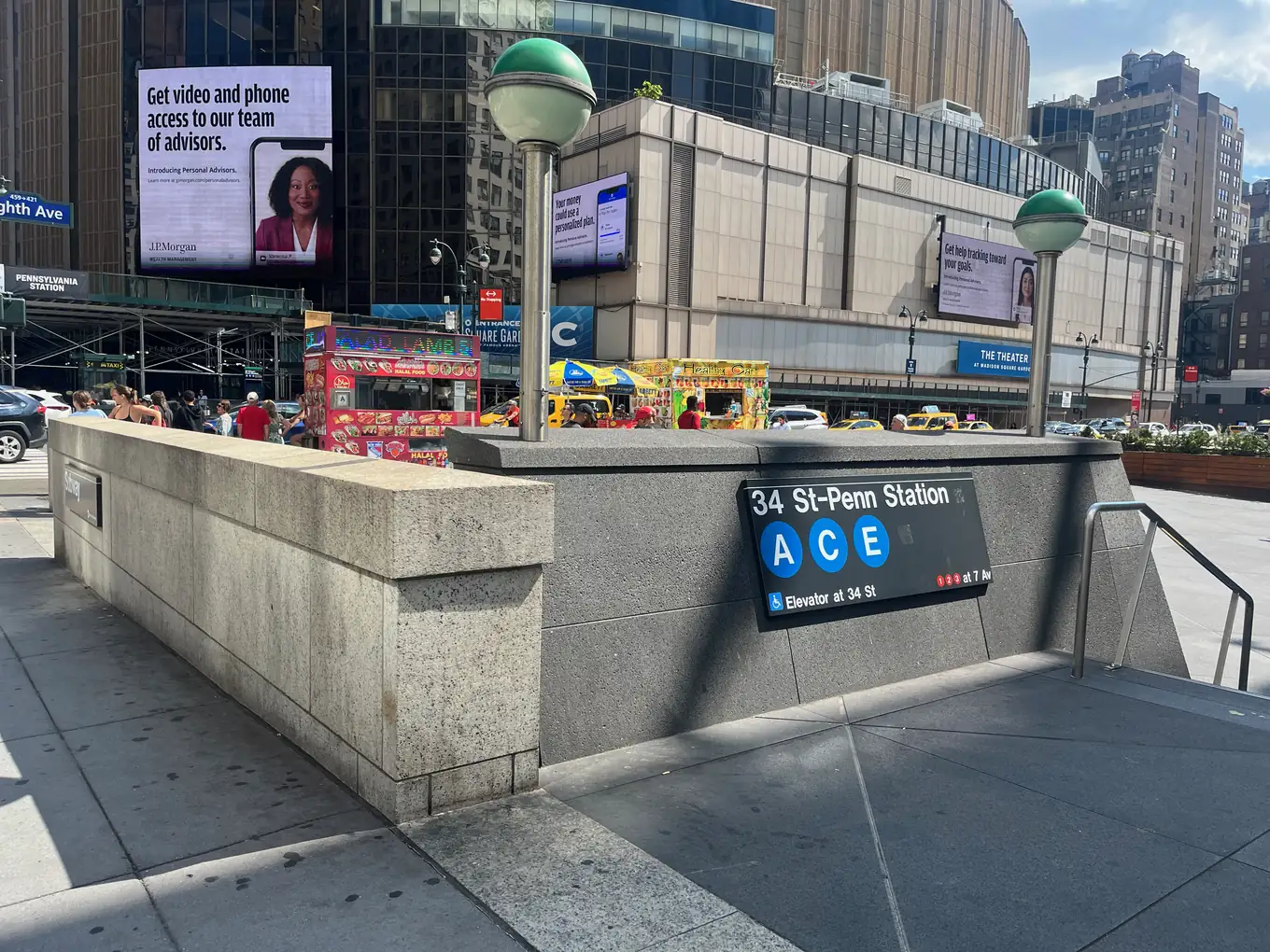
Almost nobody should drive to a weeknight game here. The 1, 2 and 3 and the A, C and E put you underneath the building at 34th Street–Penn Station, the B, D, F, M, N, Q, R and W leave you a block east at Herald Square, and the Long Island Rail Road and NJ Transit terminate downstairs.
From Metro-North it is the shuttle or the 7 across from Grand Central and then one stop down. A half past seven tip-off puts you in Penn Station at the back end of the evening commute, and coming up out of it is its own small journey, so the exit you want is the one nearest the entrance on your ticket.
The Garden has no parking garage of its own. It sits on top of Penn Station between 31st and 33rd on 7th Avenue, and the spaces near it belong to commercial garages, which is why the venue’s own answer is to book one ahead through SpotHero.
There is no rideshare zone either, so a drop-off happens on 7th or 8th Avenue between 31st and 34th, at a curb the rest of Midtown is also using. Which door you walk to is not yours to pick: your ticket names an entrance based on where you are sitting, and those doors are on different streets, so open it before you leave rather than on the sidewalk.
About an hour before tip-off
Doors open at Madison Square Garden
That is when you can get in, not when you have to. The official Madison Square Garden FAQ has the real time for your game.
Bag rules are the arena's own here and they run from a wallet-sized clutch to a bag that fits under your seat. Getting it wrong usually means walking back to the car and re-entering the line. Check the arena's page for current sizes rather than a size you remember.
Doors open an hour before tip-off, which is what every Knicks date on the Garden’s own calendar says. Warmups are the reason to use that hour rather than half of it: both teams are on the floor well before the introductions start.
At screening you are asked to empty your pockets of keys, wallet and phone and to take off hats, sunglasses and anything covering your face before you reach the line. Bags do not have to be clear but they have to fit comfortably under your seat, nothing over 22 by 14 by 9 inches gets in at all, and there is no bag check or coat check, so a bag that fails has nowhere to go. All exits are final.
Doors, lots and bag rules change; the official site is the live source.
Doors open about an hour before tip-off here; that is when the crowd starts arriving, not when you have to. Being through the doors about half an hour before tip-off covers screening, the walk to your section, and a stop on the concourse.
Work backward from tip-off: minutes in your seat beforehand, walk to your section, security screening, walk from the lot, parking, then the drive (40 minutes in the default plan). That puts leave-by at 5:59 PM for a 7:30 PM tip-off. Change the tip-off time and every row moves.
It is whatever the team has scheduled, and these are local times rather than a converted national window. On this arena's clock: a weekend matinee tips off at 12:00 PM, an early-evening game at 6:00 PM, a night game at 7:30 PM, a later start at 8:30 PM. This example uses the night game window. Cup games, holiday afternoons and nationally televised nights run their own times; the tip-off row is editable for those.
The plan allows 10 minutes for a normal walk-through queue. It runs longer in the twenty minutes before tip-off. Arriving fifteen minutes off that peak is usually enough.
About an hour before tip-off here. The official Madison Square Garden FAQ publishes the real time for your game.
Not in the lots here. If you are meeting people somewhere else, add that as a step and everything before it moves earlier.
Assume the limit is small and check the arena's own. Check the arena's own page for current sizes. The timing risk is being turned around at the door and walking back to the car: the walk twice and a second trip through the queue.
Flying in? The airport pages. Taking Amtrak? The station pages. No stadium listed? The tailgate timeline is the same plan without a particular lot.
Ready Time keeps the plan and subtracts again when the tip-off changes. Put in next week's game and the same steps land on new times, with an alert on each one.
Get a nudge at the right moment, while there's still time to act.
Each step gets its own alert, so you know what's next and how long you have.
“It has helped me tremendously to manage my timeblindness, and I tell people about it all the time.”Ready Time user, 2021