Your flight out of Calgary International leaves at a fixed time. Enter the departure time from your ticket, adjust the drive and the steps, and see when to leave and when to start packing.
Every row is editable. Tap the departure or any duration and the plan recomputes backward. The first travel row is your leave-by time.
The 25-minute drive is a typical run from Calgary without traffic. In the app, set Calgary International as the destination and Apple Maps fills in the time from where you’re leaving.
Still check traffic for the hour you’ll go (real drive to YYC). Change the row and every step before it moves.
A maps app covers the drive to YYC. Bag drop, security, and the walk to your gate usually take longer, and they are the steps people misjudge.
Here is the same plan drawn to scale. The first block is travel; the next two are the airport. A checked bag grows one, a far gate grows the other.
Front door to boarding: 2hr 30min
Two hours domestic, three international
Ahead of your departure time
That is a solid default here. Trim it only on routes and hours you already know well.
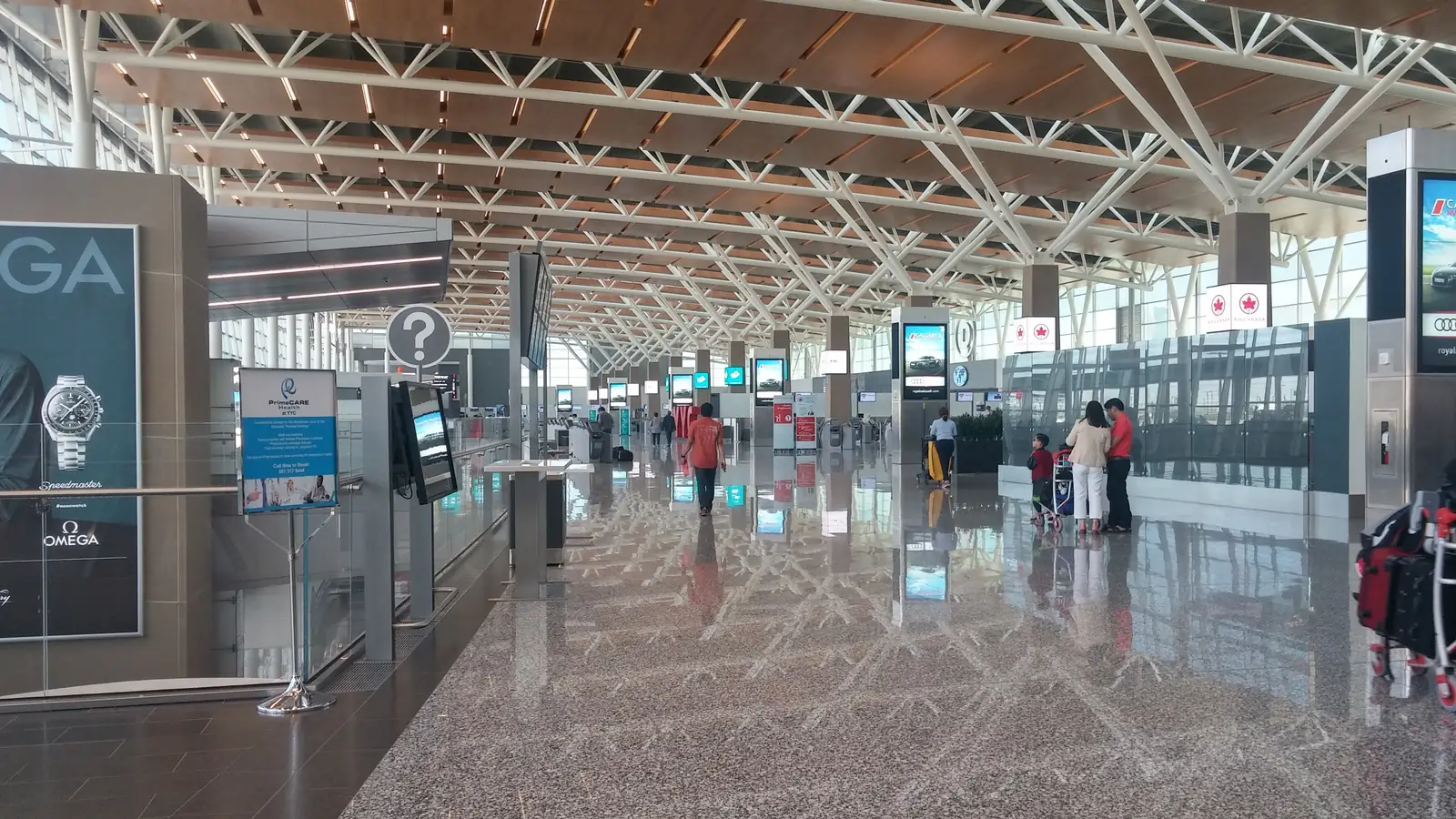
Calgary is one terminal with five concourses, and which one you leave from is settled by where you are flying rather than by which airline you booked: A, B and C are domestic, D is international, and E is everything bound for the United States. D and E are the long walk from the check-in hall, which is what the fifteen-minute default covers.
Domestic screening runs through one centralized area between doors 4 and 7, and the international and US halls have their own, so the queue you join depends on your destination rather than on when you arrive. One hard limit if you are flying to the States: YYC will not let you into screening and US customs more than two hours before departure, so starting earlier than that buys you nothing past the kerb. The early-morning bank is the reliable peak, and ski-season Saturdays add a second one in winter.
The plan allows 20 minutes for a standard lane on a busy but normal morning. With NEXUS, that drops to 10 minutes. A checked bag lengthens the one before it.
A flight to the United States out of YYC is precleared: you go through the ordinary checkpoint and then a US border officer sees you, both before you board and both inside the same hall. Set Flight to “Transborder” and the plan adds that inspection as a 25-minute row under security. Airports ask for more time on a US departure than a domestic one, so treat what the plan lands on as the floor and give yourself more of a cushion than you would at home.
Route 500, the Airport Express, is Calgary Transit's airport bus, renumbered from 300 in August 2026. Downtown out to the airport is scheduled at close to an hour, noticeably longer than the run back the other way, every 20 to 30 minutes from early morning until after midnight. Driving in from downtown is around 25 minutes up Barlow Trail or the Deerfoot. The parkades face the terminal and the Rental Car Centre is across the roadway from the domestic side, so both are walks rather than shuttle rides.
For live waits, parking, and terminal maps, check the official YYC site.
Terminals, checkpoints and transit change; the official YYC site is the live source.
Be at YYC two hours before a domestic departure and three before an international one. That is a solid default here. Trim it only on routes and hours you already know well. Treat a flight to the United States as the three rather than the two: it clears US customs at YYC before boarding. The plan above works back from there through security, bag drop, parking and the drive to a leave-by time.
The plan allows 20 minutes for a busy-but-normal standard lane. With NEXUS it drops to 10 minutes, and you can edit either one to what you actually see. A checked bag lengthens the step before it. Checkpoint detail for YYC is in the section above.
Earlier than for a domestic departure. US-bound flights out of YYC are precleared, which means an American border officer sees you here before you board instead of at the other end after you land. That inspection sits under security as its own 25-minute step, in the order you meet them: CATSA screens you, then CBP does. Boarding stays where a domestic departure has it, because preclearance is what lets these board like short-haul flights. Bag drop and the walk to your gate are unchanged, and NEXUS still applies to the screening step. The border wait is a normal-day estimate rather than a published number, so give it room.
Earlier than for a domestic one. International boarding starts 45 minutes before departure instead of 30, which pulls every step earlier. Use the airline desk for bags: documents get checked and counters often close an hour out. That also covers lap infants, unaccompanied minors, and oversized bags. If your boarding pass names a boarding time, match that.
Work backward from departure: boarding, time at the gate, the walk, security, bag drop, parking, then the drive (25 minutes in the default plan). Replace the drive with your own route. The leave-by moment is the first travel row, "Drive to YYC" by default.
Taking the train instead? The Amtrak station pages use the same kind of plan without security. The leave time calculator works for any appointment, and the wake-up time calculator runs it back to the alarm.
Two hours early still leaves the morning open: when to pack, when to leave. The plan keeps subtracting past the drive until it lands on a start time. Ready Time saves that chain and alerts you at each step, and can pick the flight up from your calendar.
Get a nudge at the right moment, while there's still time to act.
Each step gets its own alert, so you know what's next and how long you have.
“I get so tired of counting backward to when I should start my task. This app is the solution.”App Store review
Plans for the rest of the trip
Other airports