Want this on your phone? Ready Time sends an alert when it’s time to start each step.

Ready Time
You know what you need to do. Ready Time helps you know when to start.

Gates open about 90 minutes before kickoff here.
The first travel row is your leave-by time. Put in your kickoff time, tap any duration, and the plan recomputes backward.
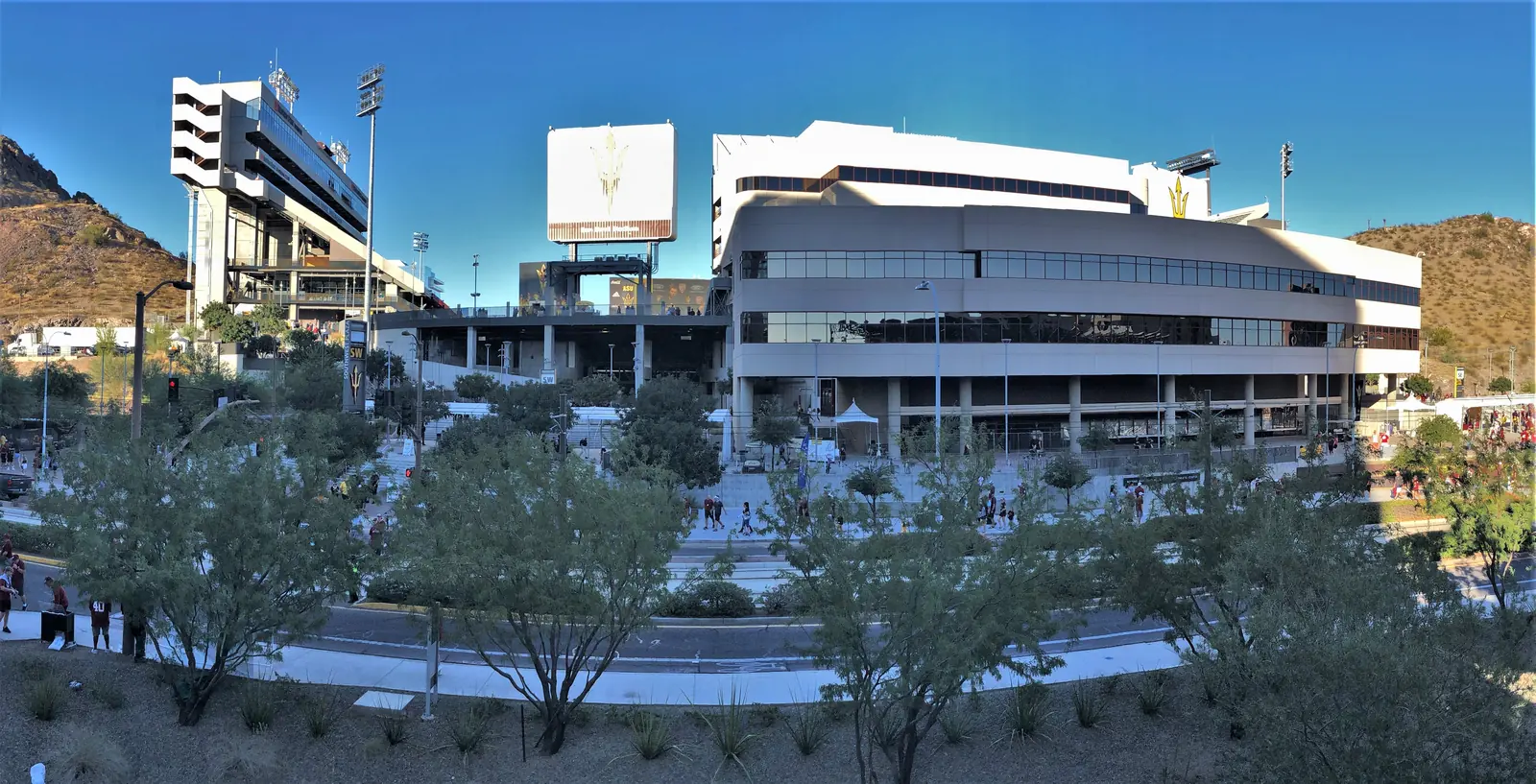
College football game day at Mountain America Stadium, home of the Arizona State Sun Devils. For a concert here, start from the concert night plan instead: doors and a support act, not gates and kickoff.
Want this on your phone? Ready Time sends an alert when it’s time to start each step.
Ready Time
You know what you need to do. Ready Time helps you know when to start.
The 20-minute drive is a typical run from Phoenix without game-day traffic (the optimistic number). In the app, set Mountain America Stadium as the destination and Apple Maps fills in the time from where you’re leaving.
Then add for game day: thousands aiming at the same exit and lots (real drive to Mountain America Stadium). Change the row and every step before it moves.
The time on your ticket is when the ball is kicked. The anthem and coin toss run before that. Aim for ten to fifteen minutes earlier if you want to be in your seat for any of it.
Gate screening usually decides it. Every big-program college stadium runs walk-through detectors, and the queue is the gap between arriving and being inside. People who miss the start rarely misjudge the drive; they misjudge the lot walk and the line.
Kickoff times are TV windows, and which one a given Saturday lands in is usually announced only six to twelve days before the game. Pick yours once it is announced and every step before it moves.
Windows are published in Eastern Time, and here the gap moves. Mountain America Stadium is on Mountain time and Arizona does not put its clocks forward, so when the rest of the country falls back in November the gap closes by an hour: three hours behind early season, two hours behind after.
The earlier window is selected because more of the season sits there. Switch it if your game is the other one.
Sep–Oct
Nov on
Weeknight games, season openers and neutral-site games run their own times. Type those in on the kickoff row.
Surface streets do most of the work here: Rural Road for the lots on the south side, Rio Salado Parkway for the ones along the water, Packard Drive for the east. The train is the better answer out of Phoenix, the A Line running to Veterans Way and College Avenue every fifteen minutes on a game day and every twenty after seven in the evening.
The Tempe streetcar also stops at Marina Heights on the north side. Two rail options at one stadium is unusual and they leave you on opposite sides of it, so pick yours by the gate printed on your ticket.
The public lots open five and a half hours before kickoff and the pass holder lots an hour and a half before that, both counted from the kickoff rather than set to a clock time. Parking is twenty dollars and an RV a hundred. Tailgating runs on beer, wine and propane, no spirits and no charcoal, and the lots have to be clear within an hour of the whistle.
About 90 minutes before kickoff
Gates open at Mountain America Stadium
That is when you can get in, not when you have to. The official Mountain America Stadium site has the real time, which moves for a night game or a TV switch.
Clear-bag policy at most college stadiums, and a few ban bags outright, clear ones included. Getting it wrong usually means walking back to the car and re-entering the line. Check the stadium's page for current sizes rather than a size you remember.
Gates open 90 minutes before kickoff and there is no re entry once a ticket has scanned. In September the heat matters more than the queue: you can carry an empty bottle through and fill it inside, the fountains are on every concourse, and the Huss Hideout upstairs is air conditioned and open to anyone.
Mountain America Stadium was previously called Sun Devil Stadium, so older directions and tickets may still use that name.
A tailgate feels open-ended until it isn't: grill, food, lock the car, walk to the gate with the whole lot. Add one and those steps go in, which means leaving earlier.
Five and a half hours before kickoff
The lots here open
You cannot get into the lot before that.
Gates, lots and bag rules change; the official site is the live source.
Save this plan in Ready Time and every step gets its own alert on game day.
Ready Time
You know what you need to do. Ready Time helps you know when to start.
Gates open about 90 minutes before kickoff here; that is when the crowd starts arriving, not when you have to. Without a tailgate, being through a gate about an hour before kickoff covers screening, the walk to your section, and a stop on the concourse.
Work backward from kickoff: minutes in your seat beforehand, walk to your section, gate screening, walk from the lot, parking, then the drive (20 minutes in the default plan). That puts leave-by at 3:08 PM for a 4:30 PM kickoff. Change the kickoff time and every row moves.
It depends on the TV window, which is usually announced six to twelve days before the game. On this stadium's clock: a noon game kicks off at 9:00 AM, the mid-afternoon window at 12:30 PM, a night game at 4:30 PM. Arizona does not observe daylight saving, so those hold until the rest of the country puts its clocks back in early November; after that each is an hour later here. This example uses the night game window. Weeknight and neutral-site games run their own times; the kickoff row is editable for those.
The plan allows 12 minutes for a normal walk-through queue. It runs longer in the twenty minutes before kickoff. Arriving fifteen minutes off that peak is usually enough.
About 90 minutes before kickoff here, rather than the two hours that is the common practice at big college stadiums. It moves for a night game or a rescheduled kickoff. The official Mountain America Stadium site publishes the real time for your game.
A short tailgate adds about an hour and a half; a full one closer to three. For a 4:30 PM kickoff that already means an afternoon in the lot. Watch packing up and the walk to the gate. Those get squeezed when the lot is having a good time.
Assume a clear bag or no bag. Check the stadium's own page for current sizes. The timing risk is being turned around at the gate and walking back to the car: the walk twice and a second trip through the queue.
Flying in? The airport pages. Taking Amtrak? The station pages. No stadium listed? The tailgate timeline is the same plan without a particular lot.
Ready Time keeps the plan and subtracts again when kickoff changes. Put in next week's game and the same steps land on new times, with an alert on each one.
Get a nudge at the right moment, while there's still time to act.
Each step gets its own alert, so you know what's next and how long you have.
“I tend to be overly optimistic when estimating how long things take, and this app has really helped me get it right.”App Store review
Ready Time
You know what you need to do. Ready Time helps you know when to start.

Other stadiums